
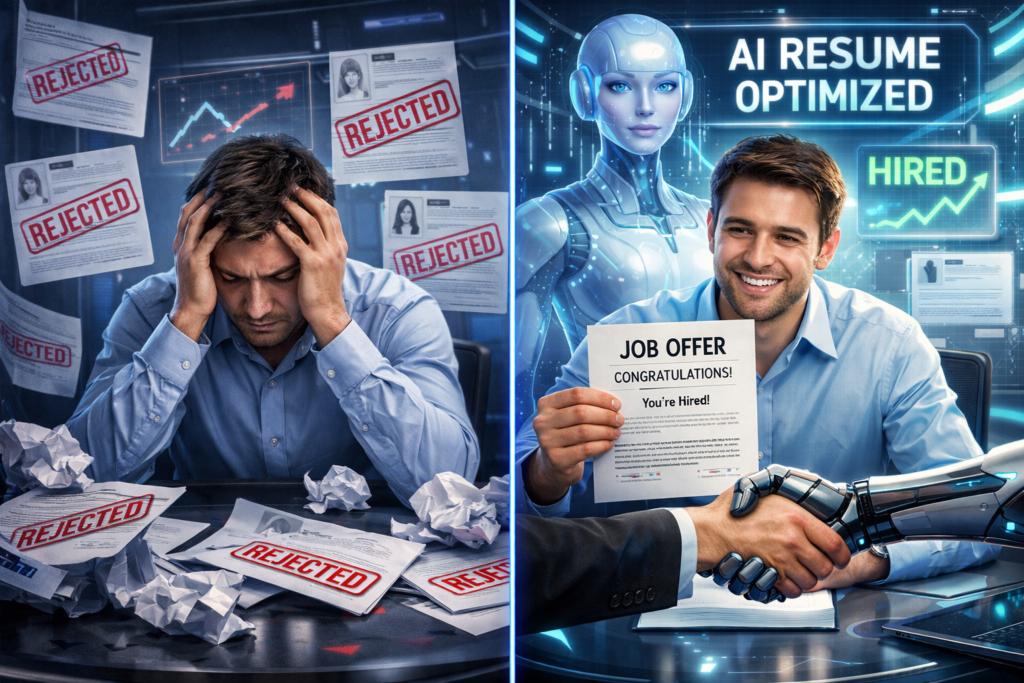
Few experiences are more discouraging for job seekers than submitting application after application without receiving a single response.
You update your resume.
You search new job boards.
You carefully submit applications.
Yet weeks—or even months—pass without interviews.
Many people assume this means they are underqualified or competing against stronger candidates.
But in many cases, the real issue lies elsewhere.
Your resume may simply not be optimized for modern hiring systems.
This is where AI resume optimization is changing everything.
The Hidden Barrier in Modern Hiring
Today’s hiring process is heavily automated.
Before a recruiter reads your resume, it is typically scanned by Applicant Tracking Systems (ATS).
These systems automatically analyze applications and rank candidates based on how well their resumes match the job description.
Recruiters then review only the highest-ranked candidates.
If your resume ranks low, it may never reach human eyes.
Even highly qualified candidates can be filtered out if their resume lacks the right keywords or formatting.
Why Many Job Seekers Get Zero Interviews
Several common problems prevent resumes from passing ATS filters.
Generic Applications
Many people send the same resume to every employer.
Unfortunately, ATS systems evaluate resumes based on how closely they match specific job descriptions.
Generic resumes rarely score well.
Missing Keywords
Job postings contain keywords related to skills, tools, and responsibilities.
If these keywords are missing from your resume, the system may assume you lack the required qualifications.
Weak Achievement Descriptions
Resumes that list responsibilities rather than results tend to perform poorly.
Recruiters prefer candidates who demonstrate measurable impact.
Poor ATS Formatting
Certain resume designs—such as graphics, complex layouts, or unusual fonts—can confuse ATS software.
This can prevent the system from properly reading your information.
How AI Resume Optimization Solves These Problems
Artificial intelligence tools are now helping job seekers dramatically improve their resumes.
Instead of guessing how to tailor a resume, AI analyzes job postings and suggests improvements automatically.
The process typically takes less than a minute.
Step 1: AI Analyzes the Job Posting
The AI scans the job description and identifies:
-
important keywords
-
essential skills
-
required qualifications
-
commonly repeated phrases
-
industry terminology
These are the same signals that ATS software uses to rank applications.
Step 2: AI Evaluates Your Resume
Next, the AI compares your resume with the job description.
It highlights areas that need improvement, such as:
-
missing keywords
-
unclear experience descriptions
-
underrepresented skills
-
opportunities to strengthen achievements
Many job seekers discover they already possess the right experience—but their resume simply doesn’t communicate it effectively.
Step 3: AI Optimizes the Resume
AI tools then suggest improved wording and structure.
This may include:
-
stronger bullet points
-
clearer achievement statements
-
improved keyword placement
-
ATS-friendly formatting
For example:
Before optimization:
Responsible for coordinating marketing campaigns.
After optimization:
Coordinated multi-channel marketing campaigns that increased online engagement by 28% and improved customer acquisition.
This version highlights impact, metrics, and relevant keywords.
Why AI Optimization Increases Interviews
AI-optimized resumes perform better for several reasons.
Higher ATS Rankings
Matching the job description more closely increases your chances of passing automated screening.
Stronger Professional Branding
AI helps transform vague descriptions into clear achievements that demonstrate value.
Faster Resume Customization
Instead of spending an hour tailoring each resume manually, AI can complete the process in seconds.
This allows job seekers to apply to more roles with higher-quality applications.
Real Results for Job Seekers
Many candidates report dramatic improvements after adopting AI resume optimization.
Common results include:
-
more recruiter responses
-
increased interview invitations
-
faster job search timelines
-
improved confidence in applications
Some job seekers who previously received no responses at all begin receiving interview requests within weeks.
While AI isn’t a guarantee of success, it significantly improves the odds.
The Future of Job Applications
Hiring technology will continue evolving.
Automation is becoming standard in recruitment, which means resumes must adapt as well.
Job seekers who embrace modern tools gain an advantage by ensuring their resumes communicate experience clearly and effectively.
AI resume optimization does not change your qualifications—it simply ensures those qualifications are presented in the best possible way.
Final Thoughts
If your job search feels stuck, the problem may not be your experience.
Your resume may simply be struggling to pass automated screening systems.
AI resume optimization offers a powerful solution by helping tailor your resume to each job description.
The result?
More visibility.
More interviews.
And ultimately, more job offers.
In today’s competitive job market, that transformation can make all the difference.