
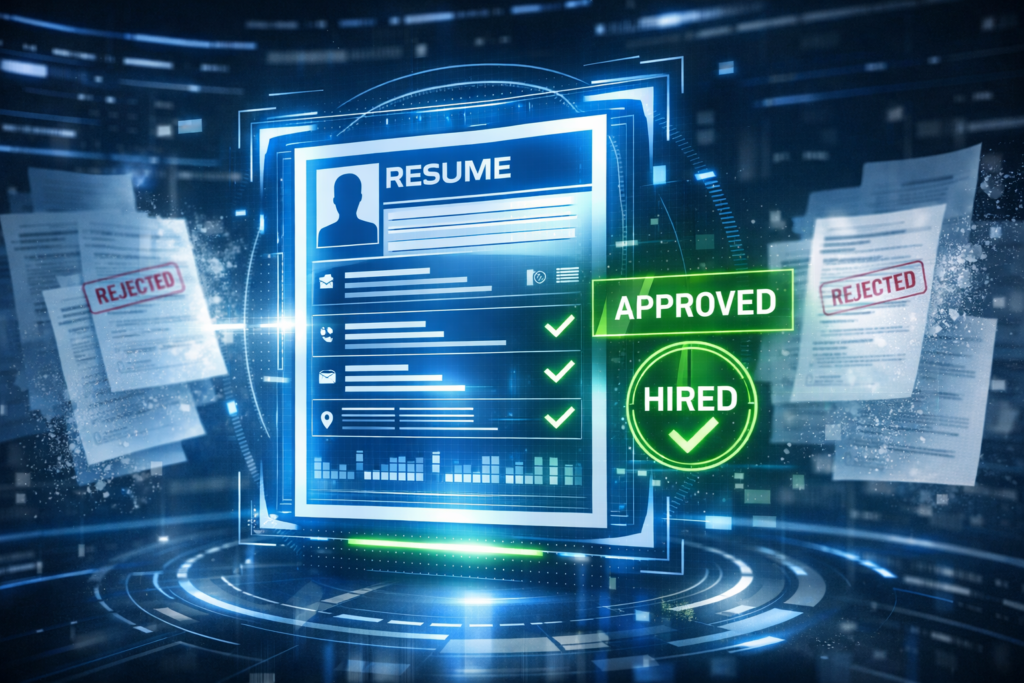
If you’ve applied for dozens of jobs and heard nothing back, the problem may not be your qualifications.
It may be your resume.
More specifically, it may be failing before a human ever sees it.
Most companies today use Applicant Tracking Systems (ATS) to automatically scan, filter, and rank resumes before they reach a hiring manager. Studies suggest 70–80% of resumes are rejected by software before a recruiter even looks at them.
That means your resume may be getting rejected within seconds of submission.
The good news?
Artificial intelligence can now fix most resume problems in under a minute.
Let’s break down how this works.
The Invisible Gatekeeper: ATS Software
When you submit a job application online, your resume usually goes through ATS software first.
This system automatically scans for:
-
Keywords from the job description
-
Relevant skills and experience
-
Job titles and industry terminology
-
Formatting compatibility
-
Education and certifications
If your resume doesn’t match the criteria strongly enough, it may never move forward.
Even highly qualified candidates are filtered out simply because their resume doesn’t contain the right keywords or structure.
For example:
A job posting might require:
-
“Project Management”
-
“Agile methodology”
-
“Stakeholder coordination”
If your resume instead says:
-
“Led team initiatives”
-
“Organized development workflows”
The ATS might fail to recognize that these are related skills.
Result: automatic rejection.
Why Generic Resumes Fail
One of the biggest job search mistakes people make is sending the same resume to every job.
Generic resumes fail because ATS systems rank resumes based on how closely they match the job description.
Hiring systems are essentially performing a keyword matching algorithm.
If your resume contains the same language used in the job posting, your ranking increases.
If not, it drops.
Think of it like SEO for job applications.
Your resume must be optimized for the job description, not just written well.
How AI Fixes This in 60 Seconds
Artificial intelligence tools now analyze job descriptions and automatically optimize resumes to match them.
Here’s how the process usually works.
Step 1: Paste the Job Description
You copy the job posting into the AI tool.
The AI scans the text and extracts:
-
important keywords
-
required skills
-
job responsibilities
-
relevant industry terminology
Step 2: Upload Your Resume
The system compares your resume against the job posting.
Within seconds it identifies:
-
missing keywords
-
weak phrasing
-
ATS formatting issues
-
skills you should highlight more clearly
Step 3: AI Optimizes the Resume
The AI then rewrites sections of your resume to improve compatibility with ATS systems.
It may:
-
add relevant keywords naturally
-
improve bullet point phrasing
-
adjust formatting for ATS readability
-
emphasize measurable achievements
For example:
Before optimization:
Managed marketing campaigns for various clients.
After AI optimization:
Managed multi-channel digital marketing campaigns, improving client engagement by 32% and coordinating cross-functional teams.
Notice how the optimized version contains keywords, measurable impact, and clearer structure.
Why This Dramatically Improves Interview Chances
Recruiters often receive hundreds of applications for a single role.
ATS systems narrow that down to a small shortlist.
AI resume optimization helps ensure you:
-
pass ATS filters
-
rank higher in candidate lists
-
match recruiter keyword searches
-
highlight relevant experience quickly
Instead of getting rejected instantly, your resume moves forward to human review.
And that’s where real opportunities begin.
AI Resume Tools Are Changing Job Searching
In the past, tailoring a resume for each job could take 30–60 minutes.
With AI, it takes seconds.
These tools can instantly:
-
analyze job descriptions
-
tailor resumes for specific roles
-
generate ATS-friendly bullet points
-
suggest stronger achievements
This is why many job seekers are now using AI as a competitive advantage in the hiring process.
The Future of Resume Writing
As hiring becomes more automated, resumes must evolve too.
Job seekers who rely solely on traditional resume writing methods may struggle against candidates using AI optimization tools.
The smartest strategy is simple:
Combine your real experience with AI-powered optimization.
Your qualifications stay the same.
But your resume becomes clearer, more relevant, and far more likely to pass hiring filters.
Final Thoughts
If your job applications feel like they disappear into a black hole, you’re not imagining it.
Many resumes are rejected before any human ever sees them.
But AI is changing the game.
With the right tools, you can now transform your resume into an ATS-optimized application in under 60 seconds—dramatically improving your chances of landing interviews.
In today’s job market, that small advantage can make all the difference.